History
The first ever ‘Old Gaffers’ race was held on the Solent in 1959, with just 13 boats. A similar race was held on the East Coast of England in 1963. The growing success of these early races, open to gaff rig boats, led to the formation of the Old Gaffers Association as a national association at the Little Ship Club, Maldon, Essex in 1963. Set up to preserve our distinctive traditional rig, in the early days this entailed rescuing or preserving some lovely old boats. Now, gaff rigged boats are being built again, some using traditional methods, whilst others use more modern materials based on traditional lines. There are even new designs emerging, continuing to develop the gaff rig. With the current love of all things ‘retro’, gaffers are becoming more popular than ever.
We now have an Archive of documents. Click on the "News" tab and select "Archive". The link is:- https://www.oga.org.uk/news/archive/gaffers_log___newsletters.html
The Association was formed in September 1963 by the entrants in the East Coast Old Gaffers Races which had been run privately in July of that year, and the entrants in the Old Gaffers Races which had been run privately in the Solent since 1958.
In 1958, three owners of gaff rigged craft based on the Hamble River had an argument as to whose boat was the fastest, and as there were no events really suitable for gaff rigged craft, they decided to arrange their own race. Word of this event spread and other owners of older gaff rigged boats asked if they could join in. The race, with a party ashore afterwards, proved quite popular, and so it became an annual event, attracting about 20 entries each year from around the Solent Area.
This event was noted briefly in the yachting magazines, and on the East Coast, the owner of a fine old cutter built back in 1872 tried to work out how he could get his boat, which was also his home, round to the Solent to take part in the race. This proved impossible, so after trying to persuade one of the local clubs to organise a similar event, he and two friends decided to follow the Solent example and arrange a race of their own in 1963.
The result proved quite a surprise for the organisers - instead of the dozen boats they expected, 30 entered for a race from Osea Island (on the River Blackwater) to Harwich. The race could hardly be called a success as calms and head winds caused all but 7 boats to retire, and even the first boat arrived in Harwich far too late for the supper which was arranged.
However, all concerned agreed that Old Gaffers Races were a GOOD THING, and the Association was formed with one of the East Coast Race organisers as Honorary Secretary.
At the end of 1963, there were 60 members.
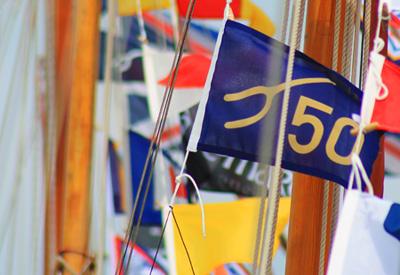

Origins of the Old Gaffers Association burgee
The origins of the burgee design have been raised over the years. John Clarke describes it in a letter he wrote to the OGA newsletter, Gaffers Log, in 1993:
"I can give you a definitive and accurate answer as it was decided at the inaugural (as it turned out) meeting of the OGA at Southgate Hotel in Winchester attended by myself, MC Richardson and the late Alex Rangabe on one cold evening in 1957 to organise the first race for the Old Gaffers. The emblem is a pitchfork as traditionally used in rural England by a country rustic or 'Old Gaffer'. A delicate and enigmatic play on words attractive at the time to all three of us."
Mike Richardson took up the tale in another letter in a subsequent Log.
"A little later, after we sent a letter to Yachting Monthly, inviting interested owners to compete in the first race, this (the burgee) appeared under the title 'Old Gaffers Race'. Hitherto, I do not think any of the triumvirate regarded themselves or their vessels as being 'old' but 'Old Gaffers' had a good wholesome sound and it soon caught on. So long live the pitchfork. You can make of it what you will - like your boat."
In 2013, the OGA celebrated its 50th anniversary with a Round Britain Challenge (RBC) culminating in a 'grand gathering of gaffers' attended by over 200 boats and 1,000 skippers, crews and their families in Cowes, Isle of Wight. The anniversary celebrations were a resounding success and the OGA sets out on its next 50 years full of optimism for a bright future.