The Design
A lot of time went into considering the target audience for the Gaffling 4.1. It was felt that something that is large enough for a family but not too big anf heavy to move about on land would be ideal.
Relatively small changes in length and beam have a large effect on the feeling of size in small boats and after some deliberation we settled on overall length of 4.1m and beam of 1.6m - a comfortable size for home building, easy to tow behind a small car, and yet large enough for family sailing. The single chine hull form follows on from the popular dinghies of the 50’s and 60’s – Hornet, Graduate, Scorpion, GP14, etc. – but with a more classic appearance with her sweeping sheer and raked transom.
Final specification:
LOA: 4.1m (13'4")
Beam: 1.6m (5'3")
Draft – c/b raised: 187mm 7", c/b lowered: 1.0m (3'3")
Sail area: 9.69m2 (104 sq.ft)
Construction Method
The concept is for an easy to build hull so the 'stitch and tape' method is employed. The hull is built over the building jig. Two bulkheads and the transom are fitted while on the frame to help support the panels around the complex curves and to give some degree of rigidity when the hull is turned over. This will also ensure that the two bulkheads are located in the correct position and then measurements can be taken from them as the interior is added.
The build jig is part of the kit and is reusable..
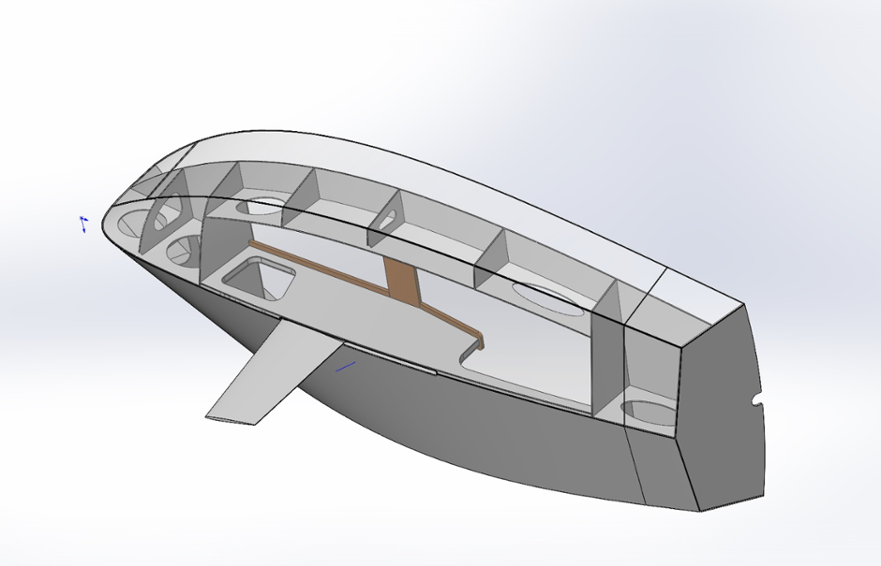
The drawing here shows the basic layout of the CNC panels and bulheads.
Plywood Panels
The hull is constructed from 6mm marine ply. The panels will be CNC cut to give accuracy to and consistency every hull.
The ply panels will be supplied as four 9' by 5' sheets for easy transportation. The routing will leave the hull panels attached to the ply sheets and the 'tabs' can then be cut through rather, like an 'Airfix' kit.

The Spars
The mast, boom and gaff are made from wood. The sections have been calculated using Douglas Fir rather than the lighter 'Sitka Spruce' so the class rules require that only Douglas Fir is used.
Tools
Most of the construction uses simple hand tools. A small router with a range of cutters for rounding edges and creating the seams etc will be needed at various points during the construction process.